
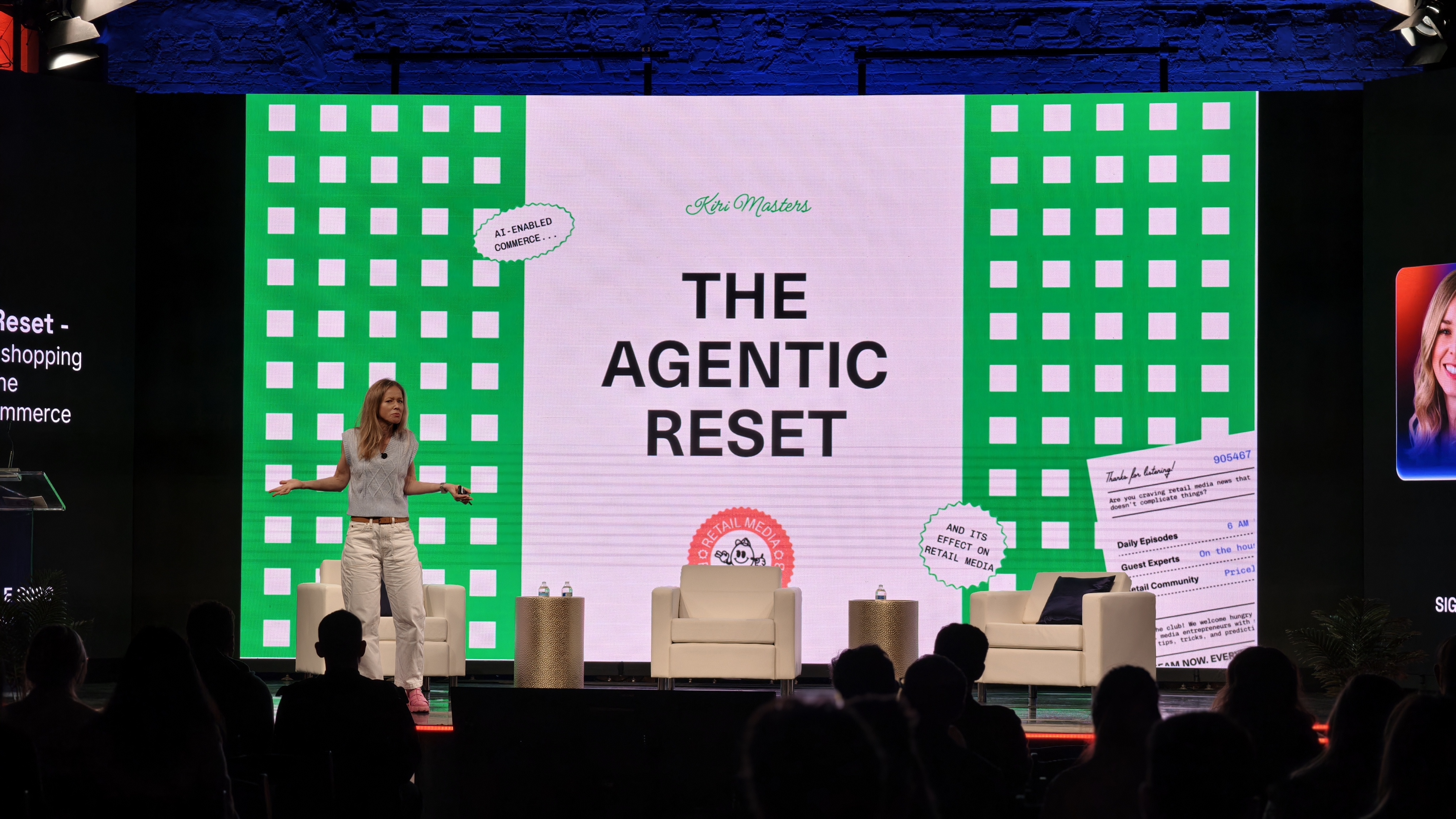
Stop Defending the Old Model. Start Building What’s Durable.
AI has already changed how consumers shop. They're using AI assistants to research products, read reviews, and make decisions, often before they ever reach a retailer's website. When they do arrive, they bypass the homepage and search bar entirely, landing directly on Product Detail Pages on a single-SKU shopping mission.
The old retail media model, built around search, browse, and on-site discovery, is losing ground fast. The brands that survive this shift won't be the ones who defend existing strategies. They'll be the ones who build for what's durable.
In her Signal to Scale 2026 keynote, Kiri Masters, host of Retail Media Breakfast Club and one of the industry's most respected independent analysts, maps exactly what this shift means, and what to do about it.
Download the full presentation to understand:
TRUSTED BY TEAMS AT






Retail media managers, heads of ecommerce, brand managers, performance marketing directors, and agency account leads who are responsible for Amazon, Walmart, or Criteo results and want to understand how AI-enabled shopping is reshaping the funnel — and what strategies hold up in the new environment. It assumes familiarity with Sponsored Ads, DSP, and basic retail media mechanics. No AMC experience required.
History shows that retail shifts follow five conditions: pain with the current model, a better technology, frictionless adoption, consumer trust, and positive economics. When all five align, a change stops being a trend and becomes the new standard.
Up to 70% of AI-referred traffic arrives without a referral tag, meaning retailers are misclassifying it as direct traffic. The result: AI's influence on your funnel is being dramatically undercounted, and the budget decisions you're making based on that data have a structural blind spot baked in.
Not all retail media investment is equally at risk. On-site sponsored search is the most exposed, as AI increasingly intercepts discovery before shoppers reach a retailer's page. In-store media remains the most defensible, physical presence is something AI cannot intercept.
The brands holding ground in the AI era share one strategic trait: they've stopped managing retail media in silos. Kiri makes the case for full-funnel integration, connecting Sponsored Ads, DSP, and AMC data to build a holistic view of the consumer journey and move budget flexibly between upper and lower funnel based on where demand actually is.
With new AI tools multiplying and budget pressure constant, knowing how to allocate across proven, scaling, and experimental tactics is the difference between intelligent testing and scattered spending. Kiri recommends the 70/20/10 framework as a practical operating model: 70% to proven methods, 20% to scaling what's working, and 10% to experimental technology.
Xnurta is the AI retail media platform brands and agencies trust to run Amazon, Walmart, and Criteo advertising intelligently. We manage campaigns across Sponsored Ads, DSP, and AMC for brands including Anker, Jackery, Greenworks, and Goal Zero.
Signal to Scale is our annual executive summit for retail media and commerce leaders. We produce it because the industry needs honest, practitioner-led conversations, not vendor keynotes. Kiri Masters was our opening speaker because she's one of the few people in this space who calls things as they are, with a decade of independent analysis behind her.
The session she delivered is some of the sharpest strategic thinking available on AI's impact on retail media. We made it available here because the industry is still operating a model built for a funnel that's already changing — and we'd rather put the right framework in front of more people than watch the gap compound.
AI-enabled shopping, or agentic commerce, involves consumers using AI assistants like ChatGPT or Gemini to research products, summarize reviews, and narrow down choices. This typically compresses the shopping journey: the consumer arrives directly on a retailer's Product Detail Page ready to purchase, having made their decision before reaching the retailer's site.
AI is shifting discovery away from retailer-owned surfaces. On-site retail media including sponsored search results is most at risk, as consumers spend less time browsing homepages or using search bars. Off-site media faces pressure as AI models develop their own consumer intent datasets, reducing the scarcity value of retailer first-party data. In-store media remains highly defensible, as AI cannot intercept physical presence or sensory context.
The 70/20/10 framework is the recommended operating model: 70% of budget to proven, reliable channels; 20% to scaling tests that have already demonstrated results; and 10% to experimental technology including generative AI for creative assets and AMC-driven audience segmentation. This structure allows for meaningful innovation without destabilizing core performance.
Kiri recommends a full-funnel approach that moves away from performance silos. This includes utilizing off-site retail media driven by first-party data, collaborating with commerce media networks (like travel and mobility platforms), ensuring PDPs are optimized for immediate conversion, and using Amazon Marketing Cloud to connect the full consumer journey across channels and surfaces.